
Stay Connected    Become a fan on Facebook Follow us on Twitter Watch USDA videos on YouTube Subscribe to receive e-mail updates View USDA Photos on Flickr Subscribe to RSS Feeds

Bad Bed Bugs

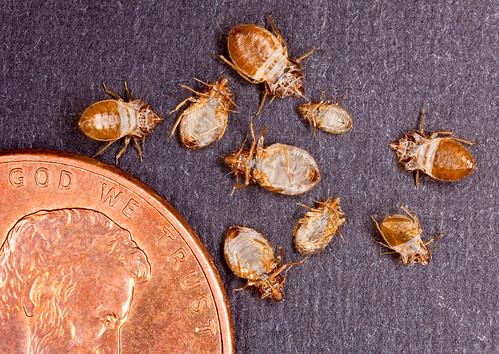
The penny in this photo provides a sense of scale to the size of bed bug skins collected for analysis by ARS scientists in Beltsville, Maryland.

The penny in this photo provides a sense of scale to the size of bed bug skins collected for analysis by ARS scientists in Beltsville, Maryland.

This post is part of the Science Tuesday feature series on the USDA blog. Check back each week as we showcase stories and news from USDA’s rich science and research profile.

Most likely you’ve heard the old saying about “sleep tight and don’t let the bed bugs bite.” The “sleep tight” part relates to old-fashioned beds in which the bedding was suspended on cords pulled tight to provide a firmer sleeping surface, but you probably don’t need any extra explanation for “don’t let the bed bugs bite”!

That saying might have been most Americans’ only knowledge of bed bugs until a decade or so ago, when the bed bug population came roaring back to infest workplaces, hotel rooms, and even our apartments and houses.  That’s why scientists with the U.S. Department of Agriculture’s Agricultural Research Service (ARS) have been working hard on finding ways to fight these tiny-but-terrible pests.

Bloodsucking bed bugs, while dirty and disgusting, don’t appear to transmit disease, but they can cause severe allergic reactions in some people.  Since the bugs are so small, they can be difficult to detect until their population is fairly large, and it can be costly to get rid of them.

The ARS scientists say one strategy for combating these creatures could be turning their own chemistry against them.  In recent studies, the scientists identified two new “alarm pheromones” that the bugs emit when they’re frightened, to tell other bed bugs to flee.

While breaking up a bed bug party sounds like a great idea under any circumstances, the scientists say causing the bugs to scatter increases the likelihood that the pests will run across an insecticide or other control agent.

The ARS scientists and a university colleague have used a technique called mass spectrometry to identify 17 compounds called “cuticular hydrocarbons,” associated with the outer protective layer of the bug.  These compounds could play a role in the beg bugs’ habit of banding together.

The scientists say these cuticular compounds and the alarm pheromones might help dogs detect bed bugs.  Canine detection of bed bug infestations is an emerging industry, and a better understanding of the chemical basis of canine detection could contribute to a harmonization of  training and detection methods—and give dogs yet another chance to live up to their reputation as “man’s best friend”!

11 Responses to “Bad Bed Bugs”

  1. Gregory says:

    So in this parable does this lead from the phrase “… Don’t let the Bed Bugs Bite” to the phrase ” Dog gone it”

  2. shannon Johnston says:

    I am so on board with public knowledge of these things. The more people know about them.. the more they can be prepared at home. If someone has them at home… & goes somewhere else to stay the night, you have a problem. I have been told to put items in the dryer to shock them with heat.. it kills them. For many of us with young children, I tell everyone I talk to about Bed bugs. Prevention is going to the be the number one defense against these… the next defense is preparation. I have bad bags on all of my mattresses as well as box springs. I have had an exterminator come out 1 full blown time.. & 1 time following to spot treat. I am still holding my breath to see if we are completely free.. but what does that mean? If someone brings them in again.. it’s back to square one. KNOWLEDGE… I sent phamplets to the kids’ school to pass them out… Parents & grandparents need to know about this… so we can be prepared.
    The first time I ran across one of these.. I thought it was a tick.

  3. Joseph says:

    Hello my name is Joe and i own a pest control business located in brooklyn new york. I am glad the USDA is doing an article on bed bugs. Its about time we have a government branch giving some time devoted to bed bugs. My office receives hundreds of calls per week related to bed bugs. Me and all my employees always speak about how the government needs to become more involved in educating the public on this matter. I think this is a step in the right direction. Also i would like to comment on something that shannon has said. She is right when she says prevention is the number one way to stop the spread of these bugs. Prevention and education. Every service i go on i try to educate the customer further on bed bug behavior. If you have any questions pertaining to bed bug and want a professional opinion visit my site at http://www.bedbugs-brooklyn.com and click the contact us link and send me any questions you may have about bed bugs. i do not mind informing the general public on preventative ways to keep these critters out of your home, and away from your family.
    Thanks
    Joe
    Northeastern Exterminating

  4. Jawad says:

    I recently read an article about a trial where the test subject was given ivermectin (a common deworming pill), and the bed bugs that fed on the subject died as a result. Check out a story at the NY Times.
    http://well.blogs.nytimes.com/2012/12/31/pill-could-join-arsenal-against-bedbugs/

  5. Dina says:

    Diatomaceous earth is a natural solution that you can buy online
    http://www.ehow.com/how_8055528_use-diatomaceous-earth-bed-bugs.html

  6. Harold says:

    So how do you know if you have bed bugs….or what to do to prevent them. This article was of no help at all.

  7. Alexiss McKinney says:

    I know I have bed bugs, I have seen three. I moved in to an apartment a month ago and the neighbors below me actually took the landlord to court about it and lost and then got evicted. Now I have them. I didn’t have any bites until a week ago now I have at least five new ones a day but I haven’t seen any in a few weeks. I found a new place to live but I don’t want to bring them with me. I can move in as soon as I can. I need to know the best and inexpensive way of going about getting rid of them. I need help as soon as possible

  8. Lola says:

    Alexxiss,
    I suggest you rub everything with alcohol before moving. The bugs are 90% of the time in your mattress since that’s where they feed from. Use insect bite anti itch cream to hel[ with the bites. If you happen to only see 3 then there are much more and most likely around the corner of your mattress.=(

  9. Ryan Flynn says:

    Yes- heat can indeed work to remove bed bugs. It is a very nice alternative to using harsh chemicals and having unhealthy fumes permeate residences and/or business locations.Although heat treatment is not offered by all pest control experts,some offer the service and guarantee it to be effective. For more information on this topic read about heat treatment for bedbugs but visiting the link below- http://www.bedbugfindersllc.com/services/heat-treatment/

    Just wondering if anyone out there has used the BuggyBeds (bed bug glue traps). The company was on shark tank and I am wondering if I should be recommending it to others? If it works, it would be helpful in the detection process.

  10. Laurel Maloney says:

    How do you tell if you have bed bugs: If you react to bed bug bites, that’s a good way to tell. Generally they bite more than once, in a zig-zag pattern. Not everyone reacts to the bites, so a thorough inspection of the bed and mattress will also be needed. Check in the seams, on the edges of the mattress, looking for adult bed bugs (reddish-brown and the size of an appleseed) and black spots (bug droppings).
    I’m an entomologist, and have been working in green pest control for over 15 years. In our quest to design something that could stop bed bugs completely, and better than pesticides, my team designed the GoodKnight self-sterilizing bed. Check it out! http://igg.me/at/goodknight/x/2912253

  11. Ameila says:

    Having pests are bad enough but having pests that you have a hard time seeing is doubly irritating. We were lucky enough to have found a place at http://www.thermalrid.com that came to our rescue and got rid of them for us.

Leave a Reply